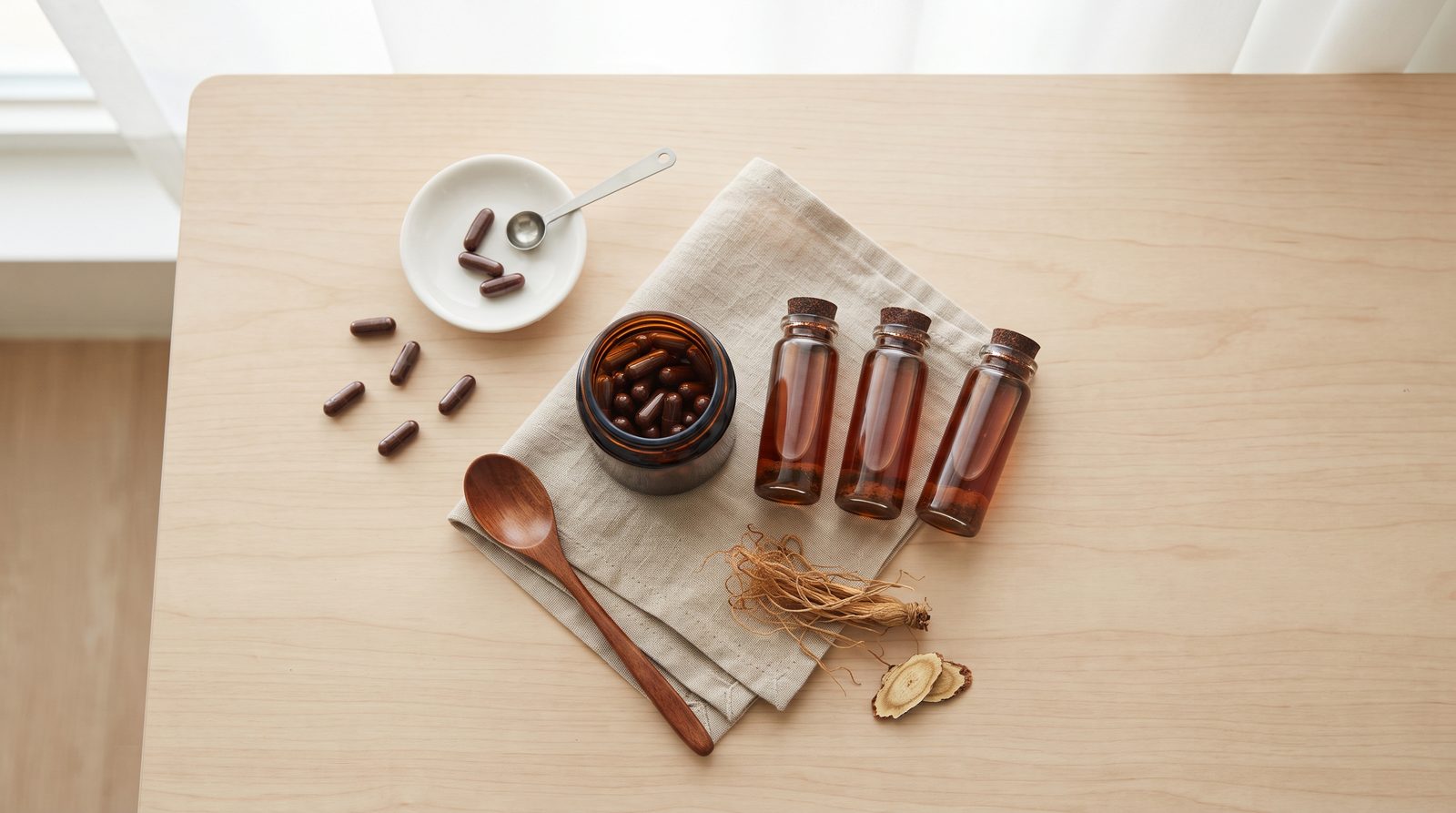
When we looked into which countries have genuinely current, government-verified data on supplement usage — as opposed to industry-funded surveys or paid market-research panels — South Korea stood out with both the highest confirmed rate and the clearest documented trend over time.
The numbers, straight from a government health survey
According to the Korea National Health and Nutrition Examination Survey (KNHANES) — the Korean government's equivalent of the US's NHANES — adult supplement usage was 67.2% in the 2023 survey cycle, up sharply from 42.9% in 2014. That's close to a 25-percentage-point increase over roughly a decade, among the steepest documented shifts in supplement usage found in any country's data.
The data also breaks down by sex across the 2014–2023 period, showing female usage ranging from 48.9% to 75.4% and male usage ranging from 34.5% to 63.8% — a consistent gap, similar in direction to the pattern seen in US CDC data, though at generally higher absolute levels.
Why South Korea's rate might be climbing so fast
A few contributing factors are plausible, though this article focuses on the verified data rather than speculating extensively: South Korea has a large, well-established domestic supplement and functional-food industry, high smartphone/e-commerce penetration (making supplement purchasing frictionless), and a cultural emphasis on preventive health that predates the current global wellness-industry boom.
A note on data reliability
It's worth being direct about sourcing here: this figure comes from a government health survey (KNHANES), which we consider a high-reliability source — the same category as CDC/NHANES in the US. We verified this specific statistic via peer-reviewed academic analyses citing the KNHANES dataset directly, rather than a secondary news article's characterization of it.
What this tells us about global supplement trends
South Korea's trajectory is a useful data point precisely because it's one of the few countries with a clean, multi-year, government-verified trend line — most countries we researched had either no recent data at all, or only a single dated snapshot. It suggests the global rise in supplement usage isn't a uniquely American phenomenon, but the pace and starting point vary substantially by country, and most of that variation simply isn't well-documented yet.
How South Korea's rate compares internationally
At 67.2%, South Korea's confirmed adult usage rate sits notably above the US figure of 60.2% from the same general survey period, and well above Australia's 33.6% (covered in a companion piece on this site). It's worth being cautious about over-interpreting cross-country comparisons, though — each survey uses its own methodology, sampling approach, and definition of "supplement," so these aren't perfectly apples-to-apples figures. What's more reliable is each country's own internal trend over time, which is why we've emphasized South Korea's decade-long climb rather than simply ranking countries against each other.
The data gap this highlights
Researching this topic across roughly 20 major economies surfaced a genuine, striking gap: most countries simply don't run a recurring, government-backed supplement-usage survey at all, or if they do, the most recent publicly available data is a decade or more old. South Korea and the US are, in this respect, unusually well-instrumented compared to most of the world — a reminder that "no data available" for a given country doesn't necessarily mean low usage, it often just means no one has measured it recently.
Source: Korea National Health and Nutrition Examination Survey (KNHANES), 2023 cycle, as cited in peer-reviewed analyses of Korean adult supplement use trends 2014–2023.